







Cotton flat sheets: how to recognise real quality
You can recognise a good cotton flat sheet by four things: the fibre length of the cotton, an honestly stated thread count, a solid weight and the fact that the fabric has not been softened with silicone. Your body lies directly on the sheet all night. That's why this is the place for pure, long-staple cotton, without synthetic fibres and without elastane. In this guide, you'll find out how flat sheets, fitted sheets and duvet covers differ, which weave suits your preferences, which sizes make sense and how to care for cotton so that it stays beautiful for years.
In brief
- Pure cotton instead of blends: you lie directly on the sheet. A fabric made of 100% long-staple cotton without elastane and without silicone feels smooth and natural.
- Quality has key figures: look for fibre length, a true thread count (around 300), weight (around 145 g/m²) and OEKO-TEX Standard 100.
- A classic flat sheet instead of a fitted sheet: a generous flat sheet is tucked in as in a hotel and fits many bed shapes.
- Measure generously: for duvet covers, the hotel size 155 × 220 cm is a good choice, for couples 240 × 220 cm.
- Care gently: wash at 60 °C, do without fabric softener and dry in the air.
Contents
- Flat sheet, fitted sheet, duvet cover: what goes where
- Why the sheet should be pure cotton
- Percale, renforcé, sateen: the weaves compared
- How to recognise a high-quality cotton sheet
- The right size for flat sheet and duvet cover
- The cotton duvet cover: closure, look, style
- Our view: why we rely on the classic flat sheet
- The First Class flat sheet from Cottonbabe
- Care: how cotton stays beautiful for a long time
- Frequently asked questions
- Sources
Flat sheet, fitted sheet, duvet cover: what goes where
If you search for cotton bed linen, you'll come across three terms that are often confused.
The flat sheet is a large, flat sheet without elastic. You lay it over the mattress and tuck the edges neatly underneath. This is how beds have always been made in good hotels. An oversized sheet adapts to different mattress heights and bed shapes because it is tucked in.
The fitted sheet has elastic all round and is pulled over the corners of the mattress. So that it fits tightly around the mattress, many fitted sheets are made as blends with an elastane content or knitted from stretchy jersey. That is practical, but such a fabric is less breathable than pure woven cotton.
The duvet cover encases your duvet, the pillowcase your pillow. Together with the sheet, they form the bed linen – everything between you and the duvet, pillow and mattress. Because the cover and sheet are in contact with you most of the time, it is worth looking for the same quality in both.

Why the sheet should be pure cotton
At night, your body gives off warmth and moisture. A sheet should be able to absorb and balance both without you lying on a slippery or clammy fabric. This is where cotton plays to its strengths: cotton bed linen absorbs the moisture released during sleep well and gradually releases it again. That's why it feels pleasantly cool, in summer and in winter.
Synthetic fibres or elastane change this behaviour. They make a fabric stretchy and easy to care for, but absorb less moisture. On the sheet in particular, where your back, legs and arms rest for hours, the pure material therefore counts.
Then there is the question of finishing. Some cotton fabrics are treated with silicone or artificial softeners after weaving. They then feel particularly soft in the shop, but this feel is a coating and not the fibre itself. We explain in detail why we do without it in our article on bed linen without silicone and polyester.
Percale, renforcé, sateen: the weaves compared
Not all cotton is the same. Besides the fibre, how a sheet feels is determined above all by the weave – the way warp and weft threads are interlaced.
| Weave | Structure and feel | In bed | Suitable for |
|---|---|---|---|
| Renforcé | plain weave, medium-fine, soft and smooth | hard-wearing, absorbent, balancing | all year round |
| Percale | finer yarns, higher thread count, smooth and rather cool | fresh, light | summer in particular |
| Sateen | satin weave, many threads lie on the surface, silky sheen | fluid, smooth, elegant | all year round |
| Jersey | knitted, stretchy | elastic, often used for fitted sheets | fitted sheets |
| Flannelette | brushed surface | fluffy, warming | winter |
The consumer portal Hessen VerbraucherFenster describes percale as finer and smoother than simple cotton and attributes durability, absorbency and temperature balance to renforcé.
Cotton sateen combines the naturalness of cotton with a particularly smooth, slightly lustrous surface. Thanks to the satin weave, more threads lie on top; the fabric flows and feels cool and supple. That's why sateen has long been the standard in upscale hotels. If you're wondering whether linen is an alternative, you'll find an honest comparison in Linen bed linen or cotton sateen: linen feels considerably rougher, whereas cotton sateen feels smooth and soft.
How to recognise a high-quality cotton sheet
Product descriptions often sound similar. With these five points, you can assess quality objectively.
- Fibre length (staple length): the longer the individual cotton fibre, the finer and more evenly the yarn can be spun. Extra-long-staple cotton (ELS) has a staple length of around 34 to 38 mm. Long fibres produce a yarn with fewer protruding fibre ends, which is smoother and less prone to pilling.
- True thread count: the thread count indicates how many threads are woven into a certain area, usually counted per square inch. What matters is that the number is arrived at honestly: from fine single yarn and not by adding up multi-ply twisted threads. A true thread count of 300 in sateen produces a dense, supple fabric.
- Weight: the fabric weight in grams per square metre shows how much material is in the fabric. A sheet of around 145 g/m² lies full and calm on the mattress without seeming heavy or stiff.
- No silicone finish: a sheet should be soft because the fibre is fine, not because it has been coated. Reputable manufacturers state that they do without silicone and artificial softeners.
- Tested to OEKO-TEX Standard 100: OEKO-TEX Standard 100 is a label for textiles that have been tested for harmful substances, from the yarn to the finished product. For bed linen that you lie in every night, this seal is an important criterion.
We have compiled further buying criteria, from the workmanship of the seams to colourfastness, in our guide Buying bed linen: 9 things to look for.
The right size for flat sheet and duvet cover
Flat sheet: better generous
In shops, sheets are often cut to mattress sizes such as 90 × 200, 100 × 200 or 140 × 200 cm. For a classic flat sheet, however, the mattress size alone is not enough: you need enough fabric on each side to cover the mattress height and tuck the sheet in deeply. Only then does it stay smooth all night.
As a rule of thumb: mattress width plus twice the mattress height plus at least 20 to 30 cm of tuck-in per side. For a 180 × 200 cm mattress with a height of 25 cm, you quickly arrive at a width of well over 270 cm. An oversized sheet such as 280 × 280 cm or 300 × 320 cm covers single, double and even round beds and can be tucked in neatly as in a hotel.

Duvet cover: length counts
The long-standing standard size for duvets and covers in Germany is 135 × 200 cm; there is also 140 × 200 cm. For tall people, both sizes are too short: the feet stick out, or the shoulders remain uncovered. That's why we recommend the hotel size of 155 × 220 cm. It gives you noticeably more room in both width and length.
If you sleep under one duvet as a couple, a double duvet in 240 × 220 cm is the best choice. That way no one has to fight for the duvet, and the bed looks calm and generous.
The cotton duvet cover: closure, look, style
With the duvet cover, two questions come into play that don't matter for the sheet: the closure and the design.
Closure: zips are common, but can press, catch in the wash and are visible. That's why we use concealed buttons instead of a zip. They lie flat, remain invisible and are easy to close. We make the hotel closure (envelope flap, no buttons) for hotels – and on request for you too: simply mention it in the order note when you order. Our comparison of types of closure for bed linen shows the pros and cons of each option.
Look: white is the colour of the hotel bed, and for good reason. White cotton looks calm and timeless and can be washed at high temperatures without colours fading. Our bed linen is always white and unprinted. Colour comes in only through the all-round piping, made of yarn-dyed, chlorine-resistant sateen. This lets you set a fine accent that suits your bedroom without the bed linen going out of fashion after a few years.
Our view: why we rely on the classic flat sheet
Our family has been working with textiles and interior furnishing since 1870; today we run Cottonbabe in the 5th generation. As a 5-star hotelier and interior designer, I see every day what makes a bed that guests love to sleep in. A large part of it is invisible: the sheet.
That's why we offer classic flat sheets instead of fitted sheets. A fitted sheet needs to stretch, and that usually comes from elastane or a knit. But your body lies directly on the sheet, and that is exactly where we want pure, long-staple cotton – without synthetic fibres, without elastane, without silicone.
Our bed linen is made of 100% long-staple cotton from the Indian highlands. The sateen has a thread count of 300, and up to 500 in our sets – exclusively with piping in Anthracite. The flat sheet has a weight of 145 g/m² and is cut so generously that it can be tucked in neatly on almost any bed. Everything is certified to OEKO-TEX Standard 100.
And because a good bed grows over the years, we offer our reorder guarantee: every piping colour remains in our range for 10 years. So you can always reorder in a matching colour, whether a second flat sheet, another pillowcase or a complete set for the guest room.
Jens Liebhauser
The First Class flat sheet from Cottonbabe
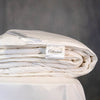
Our First Class flat sheet is a classic flat sheet made of 100% extra-long-staple cotton with a true 300 thread count and a weight of 145 g/m². It is made without elastane, without silicone and without softeners and is certified to OEKO-TEX Standard 100. It comes in the oversizes 280 × 280 cm (€79) and 300 × 320 cm (€99), both available in the shop.

To match, there is the First Class duvet cover from €159 and pillowcases from €49, all in cotton sateen with all-round piping in Anthracite, Bronze or White. If you want everything in one, choose the bed linen bundle with a 500 thread count – exclusively with piping in Anthracite. A good duvet belongs underneath: our duvets and pillows are filled with new white goose down. Shipping within Germany is free.
If the whole bed is to be right, it is also worth looking at the base: our First Class mattress with cashmere and silk is delivered by freight forwarder, not rolled and not vacuum-packed, so that it arrives in its full shape.
Care: how cotton stays beautiful for a long time
Good cotton can take a lot if you treat it properly. The Hessen VerbraucherFenster recommends the following steps for bed linen:
- Prepare: turn covers inside out and close fastenings so that nothing catches.
- Wash: at 60 °C with a heavy-duty detergent for light-coloured cotton fabrics. This is the right choice for white bed linen.
- No fabric softener: fabric softener coats the fibres. Pure, long-staple cotton is soft by nature and doesn't need it.
- Dry: in the fresh air if possible.
A few more tips from our experience: don't overload the drum, so that the large flat sheet has enough room. Take the laundry out straight after the wash cycle and shake it out well – this means fewer creases. Sateen stays particularly smooth if you hang it up neatly or iron it while slightly damp. You can read more in our guide Drying bed linen: how to keep sateen smooth and soft.
The coloured piping of our bed linen is made of yarn-dyed, chlorine-resistant sateen and designed to be washed together with the white fabric. So you don't need to separate the set by colour.
Frequently asked questions
What size should a cotton flat sheet be?
A classic flat sheet should be considerably larger than the mattress, so that it covers the mattress height and can be tucked in deeply. Our oversizes of 280 × 280 cm and 300 × 320 cm fit single, double and round beds. The higher your mattress or mattress topper, the more worthwhile the larger size.
Which material is suitable for the sheet?
That depends on your preferences, but for many people pure cotton is the balanced choice, because it absorbs moisture and feels pleasant to the touch. Cotton sateen made from long-staple fibres is also smooth and fluid. It feels smooth, pleasantly cool and calm.
Which sheet is suitable for summer?
In summer, what matters is that the sheet absorbs moisture and doesn't cling. A flat sheet made of pure cotton without elastane and without silicone is well suited. You'll find more tips for warm nights in our article on bed linen for summer.
Why doesn't Cottonbabe offer fitted sheets?
Fitted sheets need to stretch and are therefore usually blended fabrics with elastane or knitted from jersey. We want to use only pure cotton where your body rests. That's why we offer classic flat sheets that you tuck in as in a hotel.
At what temperature do I wash white cotton bed linen?
60 °C is recommended, with a heavy-duty detergent for light-coloured cotton, the covers turned inside out and fastenings closed. Do without fabric softener and dry the laundry in the air if possible.
Sources
- Changing bed linen: how often and why? (Hessen VerbraucherFenster, German)
- Bed linen fabrics for every season (DAS HAUS, German)
- OEKO-TEX STANDARD 100


Leave a comment