
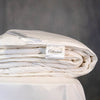








Buying a down pillow: 1 or 3 chambers, size and filling
A down pillow feels like a hotel pillow when four things come together: a filling of new, pure down, a construction that suits your sleeping position, a format that suits your bed, and a cover that lets the filling breathe. At Cottonbabe we furnish beds the way we know it from 5-star hotels. That is why our First Class down pillow is filled with new white goose down, is available as a 1- or 3-chamber pillow and carries the DOWNPASS and OEKO-TEX Standard 100 seals. In this guide you will learn how to recognise quality and which pillow suits you.
In short
- Down instead of feathers: Down is softer and fluffier than feathers and retains warmth better. This makes the pillow light and soft to nestle into.
- 1-chamber or 3-chamber: The 1-chamber pillow can be shaped freely and is soft; the 3-chamber pillow has a core that gives the head more support.
- 40 × 80 or 80 × 80: The narrow format is the classic hotel pillow, the square one the familiar format in many German bedrooms.
- Recognising quality: new down, a dense, smooth casing, clean chamber seams and verifiable seals such as DOWNPASS and OEKO-TEX Standard 100.
- Care: give it a quick shake every morning, wash it occasionally and dry it thoroughly.
Contents
- What makes a down pillow
- Quality features that matter
- 1-chamber or 3-chamber?
- 40 × 80 or 80 × 80?
- The right filling for your sleeping position
- Fill power: why a down pillow springs back
- Care in brief
- The pillow as part of the whole bed
- Our view from the hotel world
- Frequently asked questions
- Sources
What makes a down pillow
Down is the fine, fluffy undercoat of geese and ducks. Unlike feathers, it has no firm quill but forms a small, three-dimensional cloud of fine filaments. This structure traps air. That is exactly what you feel when you lay your head on a down pillow: it gives, gently surrounds you and feels light.
Feathers, on the other hand, are flatter and have a quill. They offer more support but are also the cheaper filling material. The comparison by Haus & Garten Test sums it up like this: down is softer and fluffier than feathers and insulates warmth better, while feathers give more support.
That is why you will find many blends on the market, such as pillows with a predominant feather content that are advertised as "down pillows", even though the down plays only a minor role. It is worth checking the label: it states the percentage of down and the percentage of feathers. If you would like to understand the difference in more detail, our comparison Down vs. feathers covers all the details on structure, feel and use.
In hotels, the down pillow has become established for a simple reason: a great many guests find it familiar and calm. It hardly rustles, it is light, and it can be shaped as needed in a couple of moves.

Quality features that matter
Two pillows can look the same from the outside and still feel completely different. These features set a high-quality down pillow apart from mass-produced goods:
New down instead of recycled filling
New down has its full structure. Reprocessed fillings come from products that have already been used and are cleaned and processed again. The label should clearly state that the filling is new. Our duvets and pillows are filled with new white goose down.
Goose down and colour
Goose down clusters are usually larger than duck down and therefore create more volume. White down has the advantage that it does not show through even under a light, fine cover. That is why we use white goose down.
Down content
The higher the down content, the lighter and softer the pillow becomes. Our First Class down pillow is filled with 100 % white goose down.
The casing
The casing, also called ticking, holds the down inside the pillow. It must be densely woven so that no down tips work their way through, while still letting moisture pass. A smooth, densely woven cotton fabric does both and feels calm.
Workmanship
Look for clean, straight seams and, with chamber pillows, neatly set inner walls. Continuous piping along the edge gives the pillow its shape.
Seals
Two seals give you reliable guidance. DOWNPASS stands for the origin of the down: the standard requires documented traceability of the supply chain. According to the VIER PFOTEN buying guide, such a standard gives a high level of certainty that live plucking and force-feeding were avoided during production. OEKO-TEX Standard 100 tests textiles for harmful substances. Our First Class down pillow carries both seals.
We have summarised other typical mistakes when buying pillows, from blends that are too soft to unsuitable sizes, in our 6 pitfalls when buying duvets and pillows.
1-chamber or 3-chamber?
After the filling, the construction is an important decision. Both versions have their place in hotels, and we offer both.
The 1-chamber pillow is a single, evenly filled casing. The down can move freely. You can fold the pillow, push it together or smooth it flat. It feels soft, light and very cosy. If you like to sink into your pillow and shape it a little differently every evening, this is usually the version for you.
The 3-chamber pillow is divided inside into three sections: a core in the middle and two outer chambers. The core gives the pillow structure, while the outer chambers make sure it still feels soft. The filling stays in place and does not slide to the side. The pillow keeps its height through the night.
| Feature | 1-chamber | 3-chamber |
|---|---|---|
| Feel | soft, enveloping | soft outside, with support in the middle |
| Shaping | can be shaped freely | holds its shape |
| Height through the night | gives more | stays more even |
| Often suits | stomach sleepers, people who like a flat pillow | side sleepers, back sleepers, people who want more support |
You will find both versions in our white goose down pillow in 1- or 3-chamber design.
40 × 80 or 80 × 80?
In Germany, many people traditionally sleep on a square pillow measuring 80 × 80 cm. In international hotels, by contrast, the rectangular 40 × 80 cm format is widespread.
40 × 80 cm lies under the head and neck, while the shoulders rest freely on the mattress. The bed looks tidy, and on a double bed two pillows per person can be arranged one behind the other or side by side, just as you know it from a hotel room.
80 × 80 cm offers more surface and more filling. If you read in bed in the evening and push the pillow behind your back, or simply like plenty of room, you will appreciate the square format.
Many of our customers combine both: an 80 × 80 as a back cushion for reading, a 40 × 80 for sleeping. We explain in detail which format suits your bed and your habits in our guide Pillowcase 80 × 80 or 40 × 80. For both sizes there is the matching First Class pillowcase in 40 × 80 and 80 × 80.
The right filling for your sleeping position
The pillow should fill the space between your head, neck and mattress so that you lie relaxed. The technical information from the Association of Swiss Bedding Manufacturers (VSB) gives a simple rule of thumb: the shoulder lies on the mattress in front of the pillow. On a soft mattress a lower pillow tends to fit, on a firm one a higher pillow. Broadly built people usually need a higher pillow, slender people a flatter one.

Side sleepers: When you lie on your side, the distance between ear and mattress is greater than in other positions. The pillow should have enough height for the head and neck to lie straight in line with the body. A 3-chamber pillow holds this height reliably because the core does not slip away.
Back sleepers: When you lie on your back, the neck should keep its natural shape. A medium height with some support at the neck feels calm and comfortable to many people here. Again, the 3-chamber pillow is often a good choice, because it holds its shape and is still soft.
Stomach sleepers: For lying on your stomach, the VSB recommends a flat pillow. The 1-chamber pillow can be smoothed flat and gives softly under the head.
Combination sleepers: If you change position often, a 1-chamber pillow works well, because it can be reshaped with one movement of the hand. Alternatively, put two pillows in the bed and use one or the other depending on your position.
How we handle guests' different pillow preferences in the hotel is described in our article Pillows in hotels.
Fill power: why a down pillow springs back
Fill power, also called loft, describes how much volume a down filling takes up and how quickly it recovers after being compressed. The larger and more mature the down clusters, the higher the fill power.
In everyday life you notice it like this: you press the pillow together, let go, and it fills out again. A pillow with high fill power needs less filling weight to reach the same height. As a result it stays light and airy instead of feeling heavy and compact.
New, large goose down with a pure down content provides good conditions for this. That is why we rely on pure, new white goose down for our pillow.
Care in brief
A down pillow needs little, but regular attention:
- Shake it every morning. According to Haus & Garten Test, a quick shake is enough to stop the filling from clumping and to release the moisture absorbed overnight.
- Air it. Leave the bed open in the morning instead of making it straight away.
- Change the pillowcase regularly. A high-quality cotton pillowcase protects the ticking and is quick to wash.
- Wash it occasionally. A down pillow can be washed. What matters is a mild down detergent, the care label and above all drying it completely so that the down becomes loose again.
We explain this step by step, with temperature, spinning and drying, in our guide Washing down pillows. Much the same applies to the duvet, see Washing and caring for a down duvet.
Even with good care, a pillow is an everyday item that is put under strain every night. In its technical information, the VSB recommends replacing pillows every three years.
The pillow as part of the whole bed
The hotel feeling never comes from a single item, but from how everything works together. Our First Class down pillow is available from €99, the matching First Class pillowcase in 40 × 80 and 80 × 80 from €49. You will find the full range of white goose down duvets and pillows in one collection. Shipping is always free within Germany; to Austria, the rest of the EU and Switzerland it is free from an order value of €100 (below that €9.95, or €14.95 to Switzerland, delivered duty unpaid).

The pillowcase. Our bed linen is made from 100 % extra-long-staple cotton (34–38 mm) from the Indian highlands, woven in sateen. For the thread count we use single ply: single threads, no twisted yarn, counted honestly. The individual pieces have 300 TC, the bundle in Light grey 500 TC. The fabric feels smooth, cool and calm. The bed linen is always white and unprinted; only the piping in yarn-dyed, chlorine-resistant sateen adds an accent in Light grey, Champagne or White. Concealed buttons close the cover instead of a zip. The bed linen is pre-washed and does not shrink in the wash, so you simply order the size of your pillow. Hotel customers receive the hotel closure on request. As a private customer, you can request it in the order note; the bed linen then comes without buttons.
The duvet. A pillow goes with a matching First Class down duvet, from €299. We recommend the hotel size 155 × 220 cm, because 135 × 200 or 140 × 200 are too short for tall people. For couples we recommend 240 × 220 cm.
The flat sheet. Instead of fitted sheets, we offer classic flat sheets, tucked in the way they are in hotels: made from 100 % long-staple cotton, with a weight of 145 g/m², without elastane and without silicone. They come in 280 × 280 cm for €79 and in 300 × 320 cm for €99, so flat sheets from €79.
The base. If you want to bring your bed fully up to hotel standard, you will find our First Class mattress with silk and cashmere from €1,390 and the First Class topper from €690. Our mattresses are delivered by freight forwarder, not rolled and not vacuum-packed.
For hotels. For hotels and boutique hotels we also supply hotel bed linen, pillows and duvets in larger quantities. Your contact for hotel cooperations is Jens Liebhauser, for sales Eliska Vesela, available by phone on +49 7258 210.
Our view from the hotel world
I am a 5-star hotelier and interior designer, and among other things a master interior decorator with a qualification in textile science. Our family has worked with textiles since 1870, today in the fifth generation, here in Kraichtal.
In a hotel you quickly learn that guests do not judge a pillow by its data sheet, but in the first minute. They lay their head down and immediately feel whether the pillow gives and then supports calmly, or whether it rustles, presses and is flat after an hour. That is why at Cottonbabe we chose pure, new white goose down and made the pillow in two constructions: the free 1-chamber pillow for everyone who likes it soft and mouldable, and the 3-chamber pillow for everyone who wants more support.
Just as important to me is that a bed stays consistent over the years. That is why our repurchase guarantee applies: the piping colours Light grey, Champagne and White remain in our range for 10 years. If you later add a pillowcase or another pillow, everything matches in colour. That is the idea behind timeless, white design: a bed you do not have to reinvent every few years.
Jens Liebhauser
Frequently asked questions
Can you wash a down pillow?
Yes, a down pillow can be washed. What matters is a mild down detergent, a look at the care label and drying it completely until the filling is loose and airy again. You will find the individual steps in our guide to washing down pillows.
Which pillow size is common in hotels?
In international hotels the 40 × 80 cm format is widespread, often with two pillows per person. In many German bedrooms 80 × 80 cm is the familiar size. Our First Class down pillow and the matching pillowcase are available in both sizes.
Is a 3-chamber pillow firmer than a 1-chamber pillow?
It does not feel firmer, but it holds its shape better. The core in the middle gives the head support, while the outer chambers stay soft. The 1-chamber pillow, by contrast, gives more and can be shaped freely.
How can I tell where the down comes from?
By the DOWNPASS seal. The standard requires documented traceability of the supply chain and is intended to rule out live plucking and force-feeding. Our First Class down pillow carries DOWNPASS and also OEKO-TEX Standard 100.
How often should you replace a down pillow?
The VSB recommends replacing pillows every three years because of the strain they take night after night. With daily shaking, a regularly changed pillowcase and occasional washing, the filling stays loose until then.
Sources
- Haus & Garten Test: 7 down/feather pillows tested (in German)
- VSB technical information on pillows (in German)
- VIER PFOTEN: Down buying guide (in German)


Leave a comment