







Cotton mattress topper: how it differs from latex and foam toppers
A mattress topper lies between you and your mattress – only a few centimetres, but exactly the layer you feel first. Even so, it is often bought on price rather than on what is inside it. Cottonbabe founder Jens Liebhauser, 5-star hotelier and interior designer, family tradition since 1870, sees it differently: for him, the filling decides how a topper feels.
In this guide you will learn what a topper does, how cotton, wool, latex, viscoelastic foam and polyester fibre differ, how hotels work with toppers and what to look for when buying.
What a mattress topper does
A topper is a separate layer that you place on top of your mattress. It has two jobs: it changes the lying feel, and it protects the surface of the mattress by taking on the daily load directly beneath the sheet. A topper is also easier to replace than a mattress.
“A topper on the mattress improves the lying feel once more. But a cotton topper is a completely different quality from a synthetic topper with latex and the like.”
Jens Liebhauser
A topper will not turn an unsuitable mattress into a suitable one. It complements a good base; it does not replace it. How we build the bed as a whole, from mattress to pillow, is described in Hotel bed linen at home.

Materials compared
Toppers differ above all in their filling. Each material has its own properties – here is a factual overview:
| Filling | Properties | Lying feel |
|---|---|---|
| Cotton | Natural fibre, absorbs moisture and lets air through | soft, warm, yet calm and stable |
| Wool | Natural fibre, absorbs moisture, balances temperature | soft and elastic |
| Latex | Elastic material made from natural or synthetic rubber, fairly heavy | noticeably springs back |
| Viscoelastic foam | Synthetic foam, reacts to warmth and pressure | gives way slowly, you sink in |
| Polyester fibre | Synthetic fibre, light and inexpensive, absorbs hardly any moisture | fluffy, varies with quality |
Latex and viscoelastic foam are not bad materials. Our Grand Suite mattress contains both – on the inside, between the Flexizone pocket spring core and the layers of 250 g silk on one side and 150 g wool on the other. For the very top layer, the one you lie on, Jens Liebhauser has a clear view, however: for him, that is where a natural fibre belongs.

Why breathability matters
When you lie down, your body gives off warmth and moisture. What happens to it depends on the material directly beneath you. Cotton is a natural fibre that can absorb moisture and release it again, and a loose cotton filling lets air circulate. Polyester fibre, by contrast, absorbs hardly any moisture, and dense foam lets less air through than a fibre filling. This is not a question of brand but a property of the material – and you feel it on your skin: dry or damp, pleasantly warm or stuffy.
“A real cotton topper is much more breathable. For me, polyester has no place in a topper.”
Jens Liebhauser
The same thinking applies one layer up, to duvets and pillows. How natural and synthetic fillings differ there is explained in our comparison of natural and synthetic fillings.
How hotels use toppers
In many hotels the topper is a fixed part of the bed: mattress, topper, tightly tucked sheet, duvet and pillows. It ensures the sleeping surface feels the same in every room, and it takes some of the daily strain off the mattress.
It is also practical for double beds made of two single mattresses: one full-width topper lies across both and creates a continuous surface. With the Grand Suite, two mattresses in 100 × 200 cm can be joined with a zip – a First Class Topper in 200 × 200 cm covers both.

Do you run a hotel and are planning new beds? On our For hotels page we put together individual offers. For hotel partnerships, Jens Liebhauser is your contact: +49 7258 210.
What to look for when buying
- Filling: Ask exactly what is inside the topper. “Cotton topper” should mean that the filling is cotton – not just the cover.
- Cover: It is the part closest to you. Ask what material the cover is made of.
- Height: A thicker topper changes the lying feel more than a thin one. Make sure your flat sheet can still be tucked in neatly over the combined height of mattress and topper.
- Size: The topper should match the exact size of your sleeping surface. If it is too small, you get edges; if it is too large, it creases.
- Base: A good topper works on a mattress, a box-spring bed or a sofa bed. It will not, however, make up for a worn-out mattress.
- Care: How you clean a topper depends on its filling and cover. Follow the care label and air the topper regularly, for example when you change the bed linen.
- Tested materials: The same questions apply to the topper as to the mattress. More on this in Mattress without harmful substances.
The Cottonbabe First Class Topper
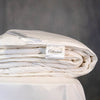
Our First Class Topper is approx. 4 cm high, and both cover and filling are made of cotton: its core consists of three layers of premium cotton. It feels soft, warm and cosy and, despite its fluffy feel, offers enough stability for a calm lying feel. The cotton filling is breathable and absorbs moisture. You can place it on a mattress, a box-spring bed or an unfolded sofa bed.
The topper is available in six sizes: 140 × 200, 160 × 200, 180 × 200, 200 × 200, 180 × 210 and 200 × 210 cm, from 690 €. It goes with our First Class mattress with cashmere and silk just as well as with the Grand Suite. You will find both in the Mattresses & Toppers collection. On top belongs a smoothly tucked First Class flat sheet made from long-staple cotton. Shipping within Germany is free.
Why our family has relied on natural materials in the mattress for generations is told in the story From horse collar to mattress.
Frequently asked questions
Topper or no topper: do I actually need a mattress topper?
No, a mattress topper is not a must. It is an additional layer that changes the lying feel of your mattress once more and protects its surface from direct wear. Whether you want one depends on how your mattress feels today and what feel you would like.
Which material makes sense for a mattress topper?
That depends on the lying feel you want. Cotton and wool are natural fibres that absorb moisture and let air through. Latex is elastic and springs back, viscoelastic foam gives way under warmth and pressure and moulds itself to you. Polyester fibre is light and inexpensive but absorbs hardly any moisture. Our First Class Topper is filled with three layers of premium cotton.
What size should a mattress topper be?
The topper should match the exact size of your sleeping surface, for example 180 × 200 cm on a 180 × 200 cm mattress. If two single mattresses lie side by side, one full-width topper can cover both. The First Class Topper is available from 140 × 200 to 200 × 210 cm.
Jens Liebhauser – founder of Cottonbabe, 5-star hotelier and interior designer, family tradition since 1870, among other things a master upholsterer/interior decorator with a certified examination in textile science


Leave a comment